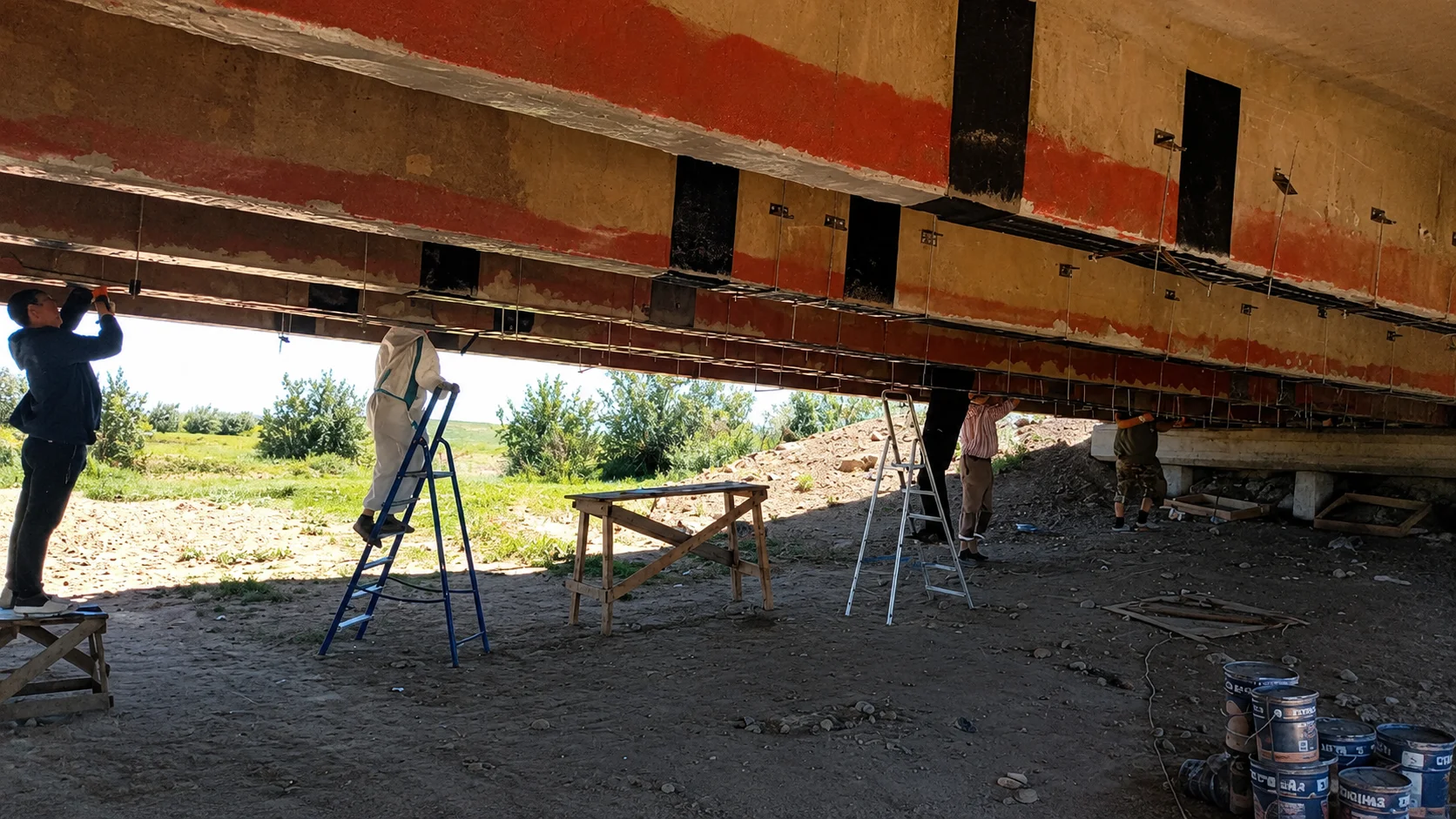
- Project Location: Highway Bridge over the Kokpekty River, National Highway KAZ 14 (KM 972+85), Karaganda Region, Kazakhstan.
- General Contractor & Project Integrator: DIPCO Engineering.
- Applied Technology: Externally Bonded Reinforcement (EBR) of load-bearing reinforced concrete structures using carbon fiber laminate strips and fabrics.
- Material Partner & Supplier: HORSE Composite Materials.
- Core Objective: Full restoration of the bridge deck girders’ load-bearing capacity under strict deadlines without interrupting active traffic flow on the KAZ 14 highway.
1. Project Background and Structural Audit
The highway bridge over the Kokpekty River serves as a vital logistics node in the Karaganda region, accommodating heavy, continuous commercial transport traffic. A comprehensive joint structural assessment conducted by KazdorNII JSC revealed critical degradation of the concrete cover, extensive cracking, and a significant deficit in the load-bearing capacity of the main longitudinal girders.
DIPCO’s engineering department was tasked with a complex challenge: design and execute a comprehensive structural strengthening project that would ensure complete long-term operational safety without increasing the dead weight of the superstructure or closing this essential traffic artery.
The optimal engineering solution selected was Externally Bonded Reinforcement (EBR) using high-performance carbon fiber composites. The HORSE product line was selected as the certified composite system supplier for the project.
2. Integrated Management and Operations by DIPCO
The successful turnkey execution of the project was driven by DIPCO’s systematic operational control and rigorous engineering standards:
- Administrative and Technical Compliance: DIPCO managed the full lifecycle of executive documentation approvals, including securing international Material Safety Data Sheets (MSDS) and technical compliance certificates for specialized epoxy formulations to satisfy state regulatory bodies.
- End-to-End Logistics: A synchronized supply chain was established, delivering specialized chemical components and CFRP materials directly from regional warehousing hubs to the site.
- On-Site Quality Assurance: DIPCO deployed a dedicated field quality control unit to monitor every installation phase, ensuring strict compliance with building codes and technical execution standards.
3. Execution Technology: DIPCO Quality Standards
Phase 1: Concrete Substrate Preparation and Restoration
Composite materials rely entirely on bond strength to transfer structural loads. DIPCO enforced stringent substrate preparation protocols:
- Surface Abrasive Cleaning: Removal of degraded concrete layers, laitance, and old coatings using heavy-duty diamond grinding equipment.
- Geometric Reconstruction: Spalls, voids, and honeycomb defects were restored using MasterEmaco S488 high-strength, non-shrink repair mortars. All sharp edges of the girders were chamfered to a minimum radius of 20 mm to prevent stress concentrations in the carbon fibers.
- Precision Surface Leveling: DIPCO’s quality assurance team mandated an additional micro-grinding pass to eliminate minor planar deviations. The surface was leveled to zero tolerance (less than 2 mm gap under a 2-meter straightedge), eliminating potential localized debonding points.
Phase 2: Substrate Priming
The fully cleaned and dust-free concrete substrate was treated with HORSE HM-180 two-component epoxy primer. This process consolidated the concrete surface pores, creating an optimal adhesive bond for the structural epoxy adhesive.
Phase 3: Longitudinal Reinforcement Installation (CFRP Strips)
The installation of Carbon Fiber Strip HM-1.4T laminates followed the structural bending moment diagrams in a multi-layered sequence:
- Layer 1: 6-meter carbon strips were bonded along the soffit (bottom face) of each of the four main girders in three parallel lines.
- Layer 2: 8-meter carbon strips were applied directly over the first layer.
- Layer 3: 12-meter carbon strips were installed as the final longitudinal layer, completely spanning the primary tensile stress zone.
DIPCO Engineering Innovation: Because vehicular traffic on the bridge remained open during installation, continuous dynamic vibrations affected the girders. To prevent adhesive shear displacement during the curing phase, DIPCO engineers rejected temporary timber shoring supported by soft riverbed soil. Instead, a rigid mechanical clamping system was engineered: steel angle plates secured via M8 threaded rods were anchored directly into the concrete, ensuring uniform pressure across the HORSE epoxy bond line.
Phase 4: Anchorage System and U-Wrap Installation
To prevent end-peeling and shear failure of the longitudinal strips, U-shaped anchor wraps made of HORSE HM-53 carbon fiber fabric were installed around the girder soffits and web faces. These transverse wraps lock the longitudinal reinforcement in place and transfer shear forces directly into the concrete compression zone.
4. Protective Coating and Final Inspection
Upon complete polymer cross-linking of the epoxy system, all temporary clamping hardware was removed. To protect the epoxy matrix from ultraviolet degradation and environmental exposure, a broadcast layer of coarse quartz sand was embedded into the top coat, followed by the application of a durable, weather-resistant protective paint system.
The completed project was formally presented to and approved by the state technical commission, including representatives from KazdorNII JSC and the client. Structural evaluation confirmed that the bridge’s load-bearing capacity was fully restored to meet modern highway loading standards.
Why Clients Choose DIPCO Engineering Solutions:
- Turnkey Execution: Comprehensive project management—from regulatory documentation and chemical sourcing to final commission approval.
- Zero Operations Impact: Proven capability to execute heavy infrastructure rehabilitation while maintaining active traffic operations.
- Uncompromising Quality Control: Rigorous internal engineering oversight eliminates defects at every millimeter of installation.
- Certified Partnerships: We collaborate exclusively with certified manufacturers of composite strengthening systems (HORSE).